Coming to the Forgotten Games iOS app

Hnefatafl

Twenty-four attackers. One hunted king. Four corners that mean freedom.

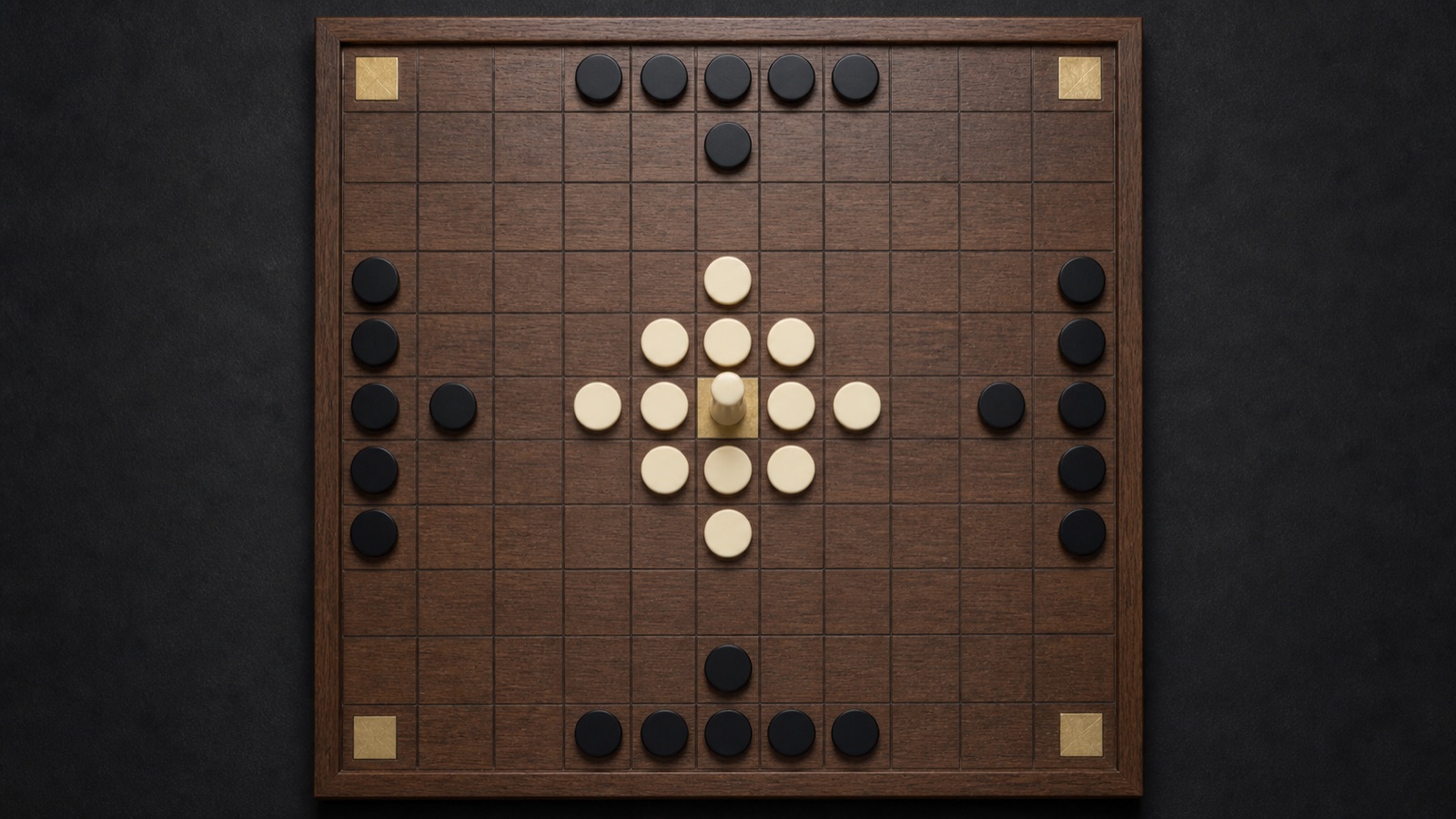
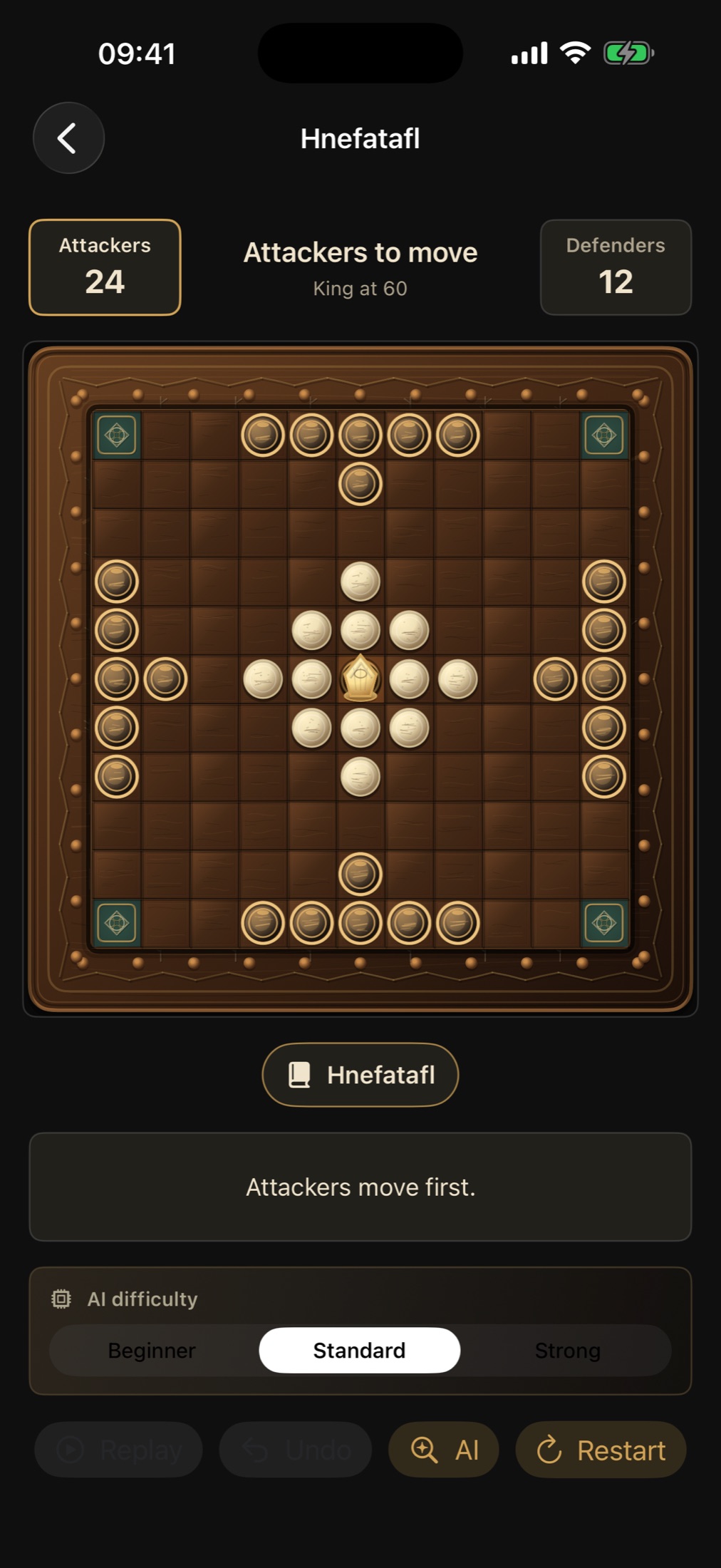
A king stands at the centre of an eleven-by-eleven board while twenty-four attackers close in from all four edges. His twelve defenders do not need to conquer the enemy; they need to tear open one route to one corner. Every move asks the same urgent question: is that gap an escape—or the beginning of the trap?

See how the app edition plays
Contemporary material study of an eleven-by-eleven Hnefatafl board in the modern Fetlar starting position Forgotten Games Hnefatafl app screen showing the modern Fetlar digital board with attackers, defenders and king on iPhone
Genuine screen from the Forgotten Games iPhone app

Beyond the board

Older tafl fragments meet a documented modern rules tradition in Fetlar.

01

A trace in the record

The older tafl trail arrives in fragments: a marked board from Ballinderry, a Welsh tawlbwrdd manuscript from 1587 and Linnaeus’s 1732 notes on Tablut. No single piece gives us a complete medieval rulebook. Together, however, they reveal the enduring idea at the family’s heart: unequal forces, a central figure and a struggle over escape.

02

People, play and memory

On Fetlar in Shetland, fragments became a playable modern tradition. From 2007, the Fetlar Hnefatafl Panel developed and play-tested an eleven-by-eleven ruleset; local championships followed from 2008, with an online event recorded in 2012. The edition here belongs to that deliberate revival: old questions made social and playable again.

03

What the map can tell us

The trail crosses Norse, Irish, Welsh, English and later Sámi contexts before reaching the modern Fetlar edition. The connections are fascinating precisely because they are not a single straight road. Fetlar names the modern rules lineage at this table, not a claimed medieval birthplace.
The turn that changes everything

This is not a fair fight—and that is the point.

The attackers have numbers, reach and the freedom to tighten the ring. The defenders have one irreplaceable piece and four distant doors to freedom. Because the goals are different, the same empty lane looks like hope from one side and danger from the other. Hnefatafl is a game about the shape of an encirclement—and the moment it breaks.

From first move to victory

How the contest unfolds

This is the selected Forgotten Games app edition. Other ways of playing exist.

  1. 01

    Begin asymmetrically

    Twenty-four attackers surround twelve defenders and their king on an 11-by-11 board. Attackers move first.

  2. 02

    Slide along the grid

    Every piece moves any distance orthogonally through empty cells. Only the king may stop on the throne or a corner.

  3. 03

    Flank the defenders

    Ordinary pieces are captured by trapping them between two hostile sides. The armed king can help the defenders capture.

  4. 04

    Escape or close the ring

    Defenders win when the king reaches a corner. Attackers seek the king’s capture, a complete encirclement or a position in which the defenders cannot move.

The version in the app

One documented path into the game.

Forgotten Games presents the modern Fetlar 11-by-11 edition identified as current-2026-02-13-with-2018-threefold. It includes corner escape, throne-only assistance when capturing the king, encirclement and a third-position repetition draw. Pass & Play, Nearby and Game Center allow players to agree a draw when they believe play cannot be completed; Solo has no agreement control. These are modern rules in the tafl tradition, built for play from evidence that does not preserve one complete medieval standard.

Follow the evidence

Sources behind this page

These are the principal records and accounts reviewed for this introduction. A source can show a dated game, ruleset or practice; it cannot by itself prove a single origin or an unchanged tradition.

  1. Eddie Duggan, “A Game on the Edge: An Attempt to Unravel the Gordian Knot of tafl Games,” Board Game Studies Journal 15(1), 2021. Directly reviewed scholarly synthesis.
  2. National Museum of Ireland, “The Ballinderry gaming board.” Directly reviewed holding-institution record.
  3. Carl Linnaeus, Lachesis Lapponica; or, A Tour in Lapland, vol. II, edited by James Edward Smith, 1811. Directly reviewed mediated English publication of the 1732 Tablut notes.
  4. Fetlar Hnefatafl Panel, “Fetlar Hnefatafl,” Fetlar community brochure, 2013. Directly reviewed modern community source.
  5. Fetlar Museum Trust and Fetlar Hnefatafl Panel, Hnefatafl: The Viking Game — 2018 Rules, 2018. Directly reviewed archived copy; the live locator was inaccessible during review.
  6. Adam Bartley; maintained by Aage Nielsen, “Rules of Fetlar Hnefatafl 11×11,” updated 13 February 2026. Directly reviewed current rules comparator.

Forgotten Games for iPhone and iPad

Hnefatafl is planned as an individual in-app purchase in Forgotten Games for iPhone and iPad.

App Store link at launch

The final App Store destination will be added before release.

Explore all seven games